Sources
| Source | What it indexes | Where to set it up |
|---|---|---|
| Sent mail | Your own past replies, as the style corpus. Always on with the assistant | Automatic |
| Folders | Markdown, text and docs in local folders | Wizard, Sources editor, [connectors.files] |
| Docs site | An llms.txt or llms-full.txt your docs publish | Wizard, [connectors.llmstxt] |
| GitHub | Repositories, cloned shallowly with your own git credentials, so private repos work | [connectors.github] |
| Notion | Pages your integration token can read | Sources editor, inboxminder set-key notion |
| Linear | Issues your API key can read | Sources editor, inboxminder set-key linear |
| Slack | Channels you list, with a user token that has channels:history | Sources editor, inboxminder set-key slack |
| Notes | What you write in the window's Your notes | Automatic |
| Canonical answers | Q&A snippets in a folder, ranked above everything else | [answers], see Drafting |
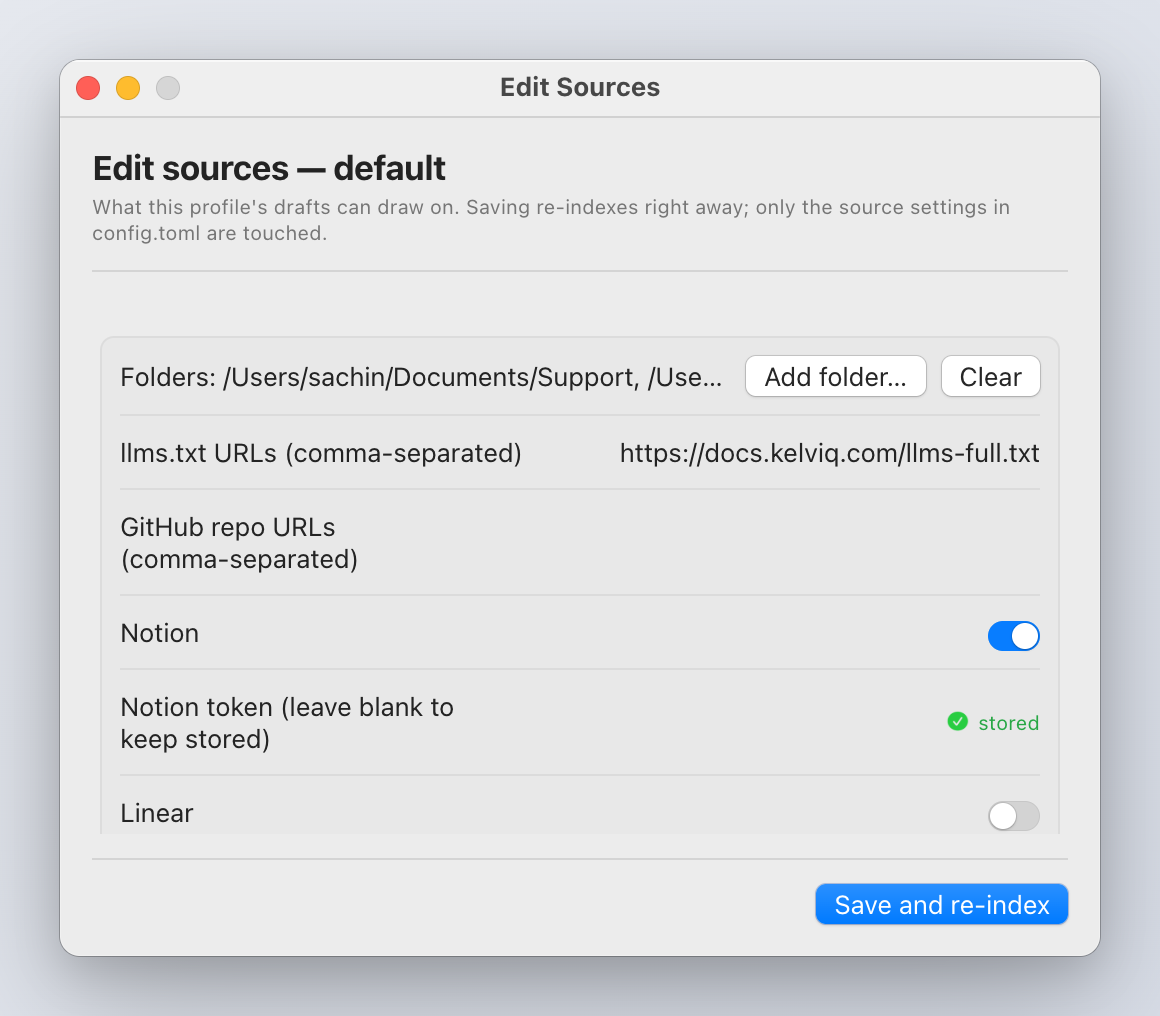
Notion, Linear and Slack tokens are read-only uses; the only write the app ever makes to any of these is filing a Linear issue when you ask for one with a label.
Indexing
The index is built when you go live, refreshed at agent startup, and every indexRefreshHours (default 24) while watching. It is incremental: each source keeps a cursor, each document a content hash, so only changed documents are re-embedded. Notes are indexed the moment you save them.
Sent mail comes in batches of sentBackfillLimit (default 200) per run, newest first, with older history backfilled one batch per run until the mailbox is exhausted. On a large mailbox the voice corpus fills over a few days.
Run it by hand:
inboxminder index                      # everything, incremental
inboxminder index --source files       # one connector
inboxminder index --full               # refetch everything (unchanged text is still not re-embedded)
Changing the embedding provider, model or dimensions needs --full; the content hashes include the embedding config, so everything re-embeds.
Excluding a document
Knowledge in the window, Stop using in drafts, or:
inboxminder knowledge docs             # find the docKey
inboxminder knowledge exclude <docKey>
inboxminder knowledge include <docKey>
An excluded document stays excluded through re-indexing; an included one returns on its next pull. The same works for a single sent email from Voice.
Seeing what a draft would find
echo "how long do refunds take?" | inboxminder knowledge search --stdin
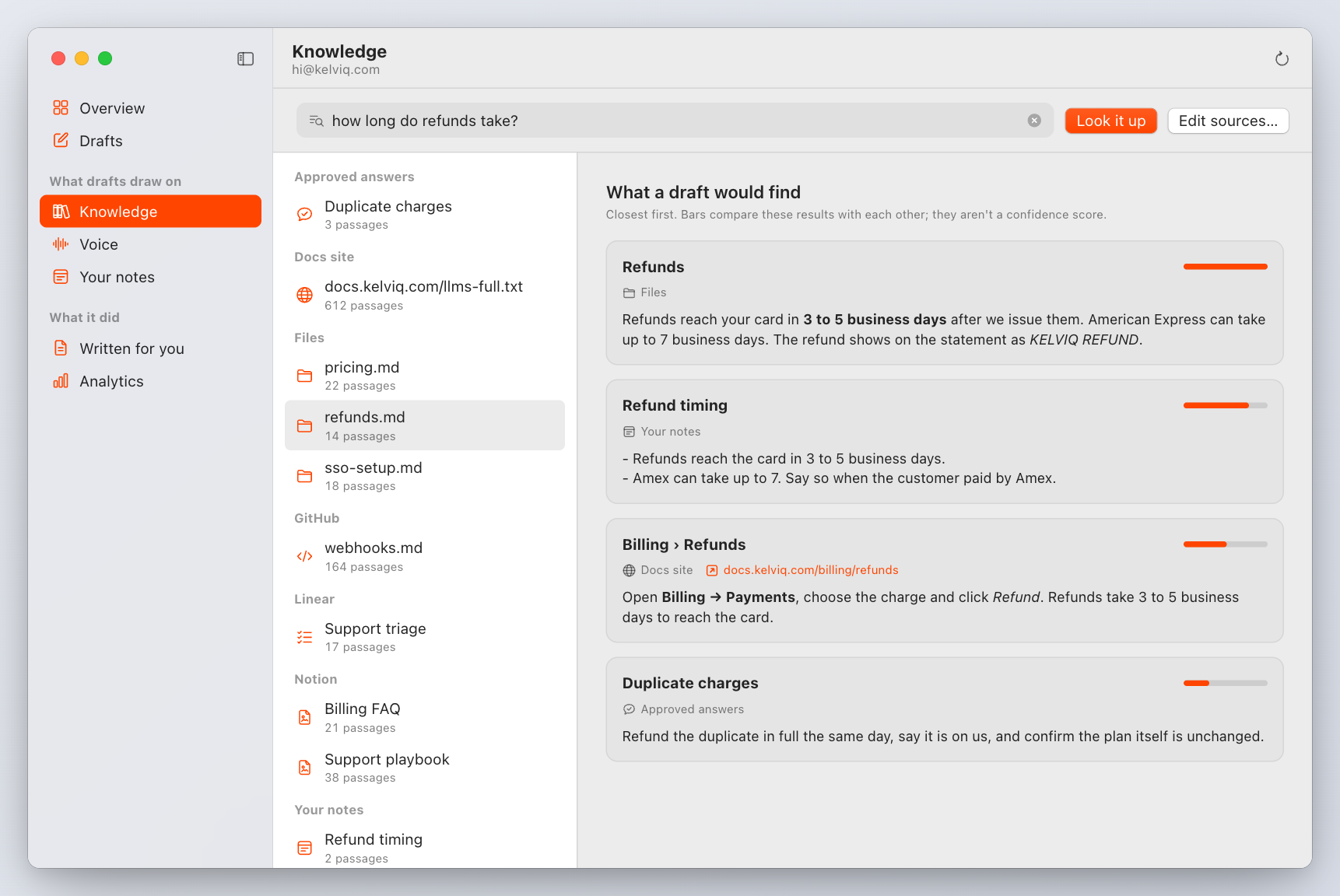
or the search box in Knowledge. If the right passage does not come up, the fix is usually a note, a canonical answer, or a better-structured document, not a prompt change.
Docs-gap drafting
With [docs] on, a customer question your indexed docs cannot answer produces a new page or a surgical edit drafted into a local docs repository's working tree. Nothing is committed, and files with uncommitted changes are never touched. The question is anonymized before the writer sees it; sender identity never reaches the page.
[docs]
enabled = true
repoPath = "~/code/docs"
sources = ["llmstxt"]     # which indexed sources count as "your docs"
instructions = "Use our MDX components; second person; never document internal tooling."
docs.instructions (Preferences → Features → Docs) steers voice, structure and topics to leave out; it cannot make a page invent facts, and gaps still get a [TODO: …]. Drafted pages appear in Written for you with an open-in-Finder link, and in inboxminder written list.